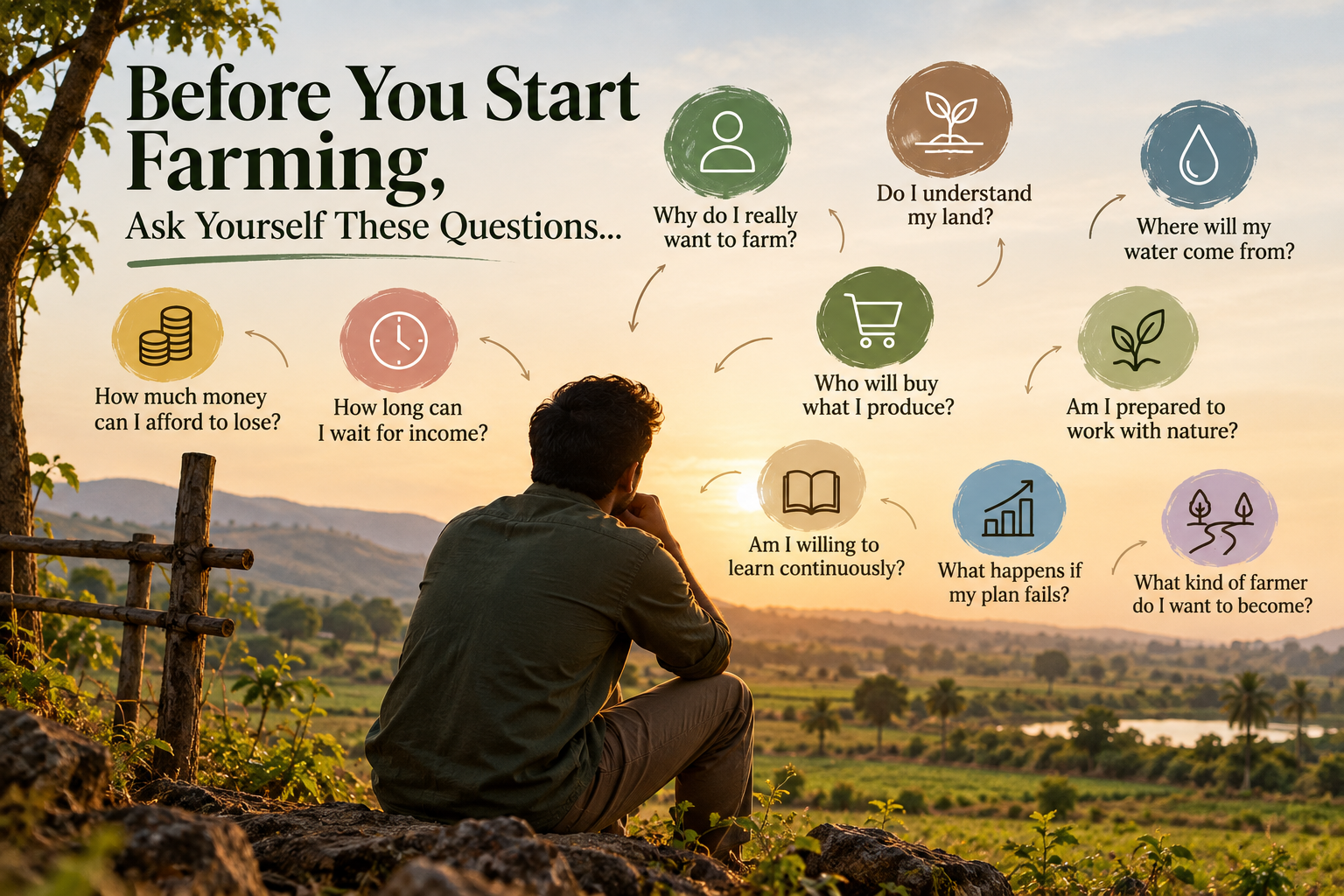
Agriculture is often romanticized. Green fields, fresh air, independence, healthy food and a life close to nature can make farming look like an obvious choice. But farming is not just about growing crops. It is a business, a responsibility, a long-term commitment and, above all, a relationship with land.
Before investing your savings, leaving a job or planting your first crop, take a step back and ask yourself a few uncomfortable but important questions.
1. Why do I really want to farm?
This is probably the most important question. Do you genuinely want to work with land, or are you simply trying to escape your current job or lifestyle? Are you attracted to agriculture because you believe it can provide a sustainable livelihood, or because you imagine farming as a peaceful life away from the pressures of a city?
There is nothing wrong with wanting a different life. But wanting to leave something is not the same as knowing what you are moving towards. Farming will bring its own pressures—weather, labour, markets, pests, water availability, finances and uncertainty. Know your reason before you begin.
2. Do I understand my land?
Every piece of agricultural land is different. Before choosing a crop, understand:
- Soil type and soil depth
- Water availability and drainage
- Rainfall pattern, temperature and wind conditions
- Existing vegetation, land slope and topography
- Previous crops and farming practices
A crop that performs beautifully on someone else's farm may fail on yours. Don't choose a crop first and then try to make your land suitable for it. Start by understanding the land.
3. Where will my water come from?
A crop can survive many challenges, but lack of water at the wrong time can destroy an entire season. Ask yourself: How much water do I actually have, and how reliable is it? Don't calculate only the water needed during the first year. Consider the requirements when plants become mature.
Also consider borewell reliability, rainwater harvesting, storage, drip irrigation, water quality and summer availability. A farm should be designed around its real water situation, not an assumed one.
4. Who will buy what I produce?
Growing a crop is only half the job. The other half is selling it. Before planting, find out who your customer is. Study local and wholesale markets, traders, direct consumers, processing industries, farmer-producer organisations, seasonal price patterns, transportation costs and quality requirements.
A good harvest without a good market can still result in a poor business. Don't ask only, “What can I grow?” Ask, “Who will buy it?”
5. How much money can I afford to lose?
This question is uncomfortable—but essential. Agriculture is exposed to risks that are difficult to control: crop failure, drought, excess rain, pest outbreaks, disease, price crashes, labour shortages and equipment failures.
Never invest money in farming that you cannot afford to lose. Prepare a realistic budget covering land development, irrigation, fencing, planting material, labour, maintenance and the period before the farm starts generating meaningful income. Keep an emergency reserve outside the farm.
6. How long can I wait for income?
Different crops have completely different timelines. Some provide income within months. Others take several years. Before planting, make a simple timeline: Investment → Establishment → First harvest → Regular production → Break-even.
If your financial situation requires monthly income, don't choose a farming model that provides meaningful returns only after several years. Your farming plan must match your financial timeline.
7. Am I prepared to work with nature?
If you want to practise natural farming, this question becomes even more important. Natural farming is not simply “Stop using chemicals.” It requires thinking about the farm as an ecosystem.
Learn about soil organic matter, mulching, ground cover, biodiversity, beneficial organisms, water conservation, compost and organic matter, crop diversity and pest ecology. The goal is not to fight every insect, weed or microorganism. The goal is to create a farm where ecological processes do more of the work.
8. Am I willing to learn continuously?
No farmer knows everything. Agriculture changes constantly because climate, markets, technology and farming knowledge keep changing. Read. Talk to farmers. Visit farms. Observe. Experiment on a small scale. Record what happens.
Most importantly, be willing to change your opinion when the land teaches you something different. A farm can become a classroom—but only if you are willing to learn from it.
9. What happens if my first plan fails?
This is one of the most important questions that rarely gets asked. Suppose your crop doesn't perform, the price falls or the borewell fails. What will you do?
Good farming isn't about having a perfect plan. It is about having a plan that can survive imperfect conditions. Diversification, multiple income sources, proper cash reserves and gradual expansion can make a farm more resilient.
10. What kind of farmer do I want to become?
Do you want to maximise production, build a natural farm, create a profitable commercial farm, preserve your land for the next generation, produce food for your family or build a farm-based business?
There is no single correct answer. But your answer should determine your farming model.
Agriculture Begins Before the First Seed
The first step in farming isn't buying seedlings. It isn't digging a borewell, installing drip irrigation or even preparing the soil. The first step is asking the right questions.
Understand yourself. Understand your land. Understand your water. Understand your market. Understand your finances. Then choose what to grow.
Before you grow a crop, understand the land. Before you invest in a farm, understand yourself.