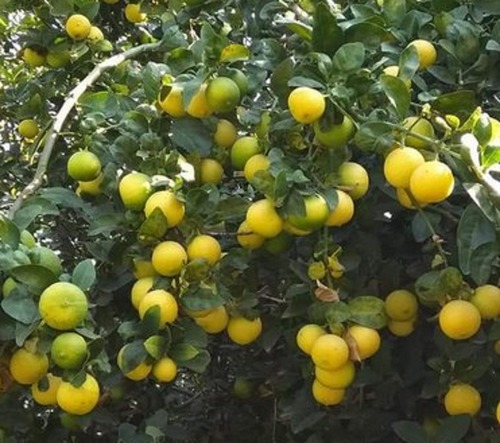
An introduction to the traditional Kagzi lime of the Indi region, its suitability for dryland farming, and the natural farming practices that can help maintain a healthy orchard.
1. What Is Kagzi Lemon?
Kagzi lemon, commonly known as Kagzi lime, is a traditional lime variety associated with the Indi region of Vijayapura district in Karnataka. Locally, it is known as Indi Lime and is valued for its importance to the region's agricultural identity.
In the Vijayapura region, farmers sometimes refer to Kagzi lime as an “ATM crop” because seasonal sales can provide valuable income. With suitable growing conditions and careful orchard management, it can become a long-term agricultural asset.
Indi Lime has also received a Geographical Indication (GI) tag, recognising its regional identity. Farmers interested in cultivating this variety should ensure they obtain planting material that is genuine and suited to the region.
2. Is Kagzi Lemon Suitable for Natural Farming?
Kagzi lime can be cultivated using natural farming principles. These include maintaining soil cover, reducing unnecessary soil disturbance, managing water carefully, and encouraging a healthy soil ecosystem.
The crop is particularly worth considering in relatively dry regions such as parts of Vijayapura district, where farmers are looking for alternatives to conventional field crops.
However, Kagzi lime is not equally suitable for every location. Climate, rainfall, soil drainage, water availability and local disease pressure all influence orchard performance.
Sunlight is important for Kagzi lime. The crop generally performs best in a sunny location. Areas with prolonged heavy rainfall or waterlogged soils may present challenges, particularly where drainage is poor. Before planting in a new region, farmers should assess local conditions and seek advice from experienced growers or horticultural experts.
3. Can Kagzi Lime Become a Long-Term Orchard?
A well-maintained Kagzi lime orchard may remain productive for several decades. Under favourable conditions, a lifespan of 40 years or more may be possible, although this is not guaranteed.
Long-term orchard health depends on several factors:
- Suitable soil and climate.
- Healthy, true-to-type planting material.
- Appropriate irrigation and drainage.
- Good mulching and soil management.
- Timely monitoring of pests and diseases.
- Careful harvesting and orchard maintenance.
Natural farming aims to maintain the health of the soil and the wider farm ecosystem over time. Rather than relying only on short-term inputs, the approach gives importance to protecting the soil, retaining moisture and reducing unnecessary disturbance around the trees.
4. Mulching: Protecting the Soil Around the Trees
Mulching is an important practice in a natural farming orchard, especially in hot and dry regions.
A suitable layer of organic mulch can help reduce moisture loss, moderate soil temperature, limit weed growth and gradually add organic matter as it decomposes.
Possible mulch materials include dry leaves, crop residues, grass that has dried appropriately and other clean organic materials available on the farm.
Keep mulch away from direct contact with the trunk. Leaving a small clear space around the stem helps reduce excessive moisture accumulation and the risk of collar or stem-related problems.
Mulching should be managed according to the season, soil moisture and the availability of material. It complements irrigation; it does not eliminate the need to provide water when the crop requires it.
5. Water Management: Avoid Excess Water
Water management deserves special attention when growing Kagzi lime.
Although citrus trees need water for healthy growth, excessive irrigation and waterlogged soil can damage roots and increase the risk of root diseases. Too little water, particularly during hot weather and important growth stages, can also stress the trees.
The objective is to maintain adequate soil moisture without keeping the root zone saturated.
Practical water-management principles:
- Provide water according to the soil, weather, tree age and crop requirements.
- Ensure that excess water can drain away.
- Avoid directing irrigation water continuously against the trunk.
- Apply water around the root zone rather than concentrating it at the stem.
- Monitor the soil before irrigating again, especially after rainfall.
- Use drip irrigation where practical, with emitters positioned to wet an appropriate part of the root zone.
There is no single irrigation schedule suitable for every orchard. Sandy, loamy and clay-rich soils retain water differently, so farmers should adapt irrigation to their field conditions.
6. Why Avoid Unnecessary Tilling Inside the Orchard?
In a natural farming system, unnecessary tilling between established lime trees should be avoided.
Citrus trees develop feeder roots near the soil surface as well as deeper roots. Repeated or deep cultivation can damage these roots, disturb soil structure and affect the organisms living in the soil.
Instead of repeatedly tilling the entire orchard, farmers can consider:
- Maintaining organic mulch between trees.
- Managing weeds through appropriate non-destructive methods.
- Growing suitable cover crops where water availability and orchard age permit.
- Adding organic residues to the soil surface.
- Minimising soil disturbance around the trees.
The goal is not to leave weeds unmanaged. It is to manage ground cover without repeatedly disturbing the soil and damaging tree roots.
7. Planting Distance: How Many Trees Fit in One Acre?
Planting distance affects sunlight, airflow, root competition and the ease of carrying out orchard operations.
At a spacing of 20 feet × 20 feet, each tree occupies approximately 400 square feet.
One acre contains 43,560 square feet, giving a theoretical estimate of about 108 trees per acre.
The actual number may be lower after allowing for field boundaries, paths, irrigation infrastructure and other practical requirements.
Before finalising the layout, farmers should consider the expected mature canopy, soil conditions, equipment access and local horticultural recommendations. The right spacing helps create a manageable orchard rather than simply maximising the number of saplings planted.
8. Choosing Kagzi Lime Saplings
Selecting suitable planting material is one of the most important decisions when establishing an orchard.
In the traditional cultivation approach described by some regional growers, seed-grown seedlings are preferred. The planting material should be healthy, vigorous and obtained from a reliable source.
When selecting seedlings, consider the following:
- Choose seedlings that are preferably less than one year old, as appropriate for the planting season and field conditions.
- Look for healthy leaves, a strong stem and a well-developed root system.
- Avoid plants with damaged roots, visible pests, disease symptoms or weak growth.
- Confirm the variety and origin with the nursery or supplier.
An important consideration: Seed-grown lime trees may differ in their growth, fruit quality and time to bearing because seedlings are not genetically identical to the parent tree. Grafted plants can offer greater uniformity and may bear earlier. Farmers should compare these options and choose according to their objectives, budget and access to reliable planting material.
For anyone establishing an orchard specifically for Indi Lime, verifying the variety is especially important.
9. Kagzi Lime as an Income Crop
In the Vijayapura region, Kagzi lime is valued as a potential source of seasonal income. Farmers may receive attractive prices during periods of strong demand or limited supply, including some summer periods.
However, market prices vary with season, fruit quality, supply, demand and transport costs. High prices in one season do not guarantee the same returns every year.
Before investing in an orchard, farmers should examine local market prices, talk to growers, understand the time required for trees to begin bearing, and plan for the years when the orchard is still developing.
A long-term orchard is best treated as a planned agricultural investment rather than a guaranteed source of immediate income.

10. Building a Natural Farming Orchard
Kagzi lime offers an opportunity to combine a regionally important crop with natural farming practices. Maintaining soil cover, avoiding unnecessary tillage, managing irrigation carefully and selecting suitable planting material can all contribute to better orchard management.
The most important lesson is that natural farming is not simply about avoiding particular inputs. It requires farmers to observe their soil, trees, water and local climate, then adjust practices accordingly.
For farmers considering Kagzi lime, the best starting point is to learn from experienced growers, understand local conditions and establish the orchard with a clear long-term plan.
LemonRoots perspective: Healthy soil, careful water use and informed decisions are the foundations of a resilient orchard. By learning from the land and from farmers' experiences, we can work towards farming systems that support both livelihoods and the natural environment.
Editorial note: The observations in this article reflect regional farming knowledge and natural farming principles. The expected lifespan, performance, irrigation needs, planting material and economic returns of Kagzi lime depend on local conditions. Farmers should verify GI-related details and seek locally relevant horticultural guidance before making major investments.